
Peer Observation of Teaching Recommendations
Peer Observation of Teaching Recommendations
Overview
This page offers formative peer‑observation tools designed to help faculty reflect on and strengthen their teaching practice. Faculty may engage in peer observation with a colleague of their choice or request support from CTLE’s instructional design team, which facilitates reflective conversations, formative observations, and resource selection to promote continuous improvement in teaching.
Why Peer Observation of Teaching?
Peer Observation of Teaching is a collaborative, structured process where faculty observe one another’s teaching and reflect together on their pedagogical approaches. This can happen in a classroom, online environment, or by reviewing course materials. (For online teaching specific tools, see section below) The goal is to better understand teaching practices, reflect on them, and identify opportunities for improvement.
Peer observation also provides discipline‑aware insight into parts of teaching that students cannot reliably assess. These include instructional design, rigor, alignment, and pedagogical decision‑making. By participating in a formative peer observation, instructors create a space to:
- Build community and shared learning
- Support improvements in teaching practice
- Help observers strengthen their own teaching
- Provide additional evidence beyond student feedback
- Reflect on the relationship between learning outcomes, classroom activities, and student assessment.
- Gain insight into how students experience their teaching, including where learning may break down.
- Recognize gaps between intended outcomes and observed student behaviors.
- Expand empathy for students by seeing a lesson from their perspective.
This site's resources focus specifically on formative peer observation. A formative approach emphasizes support, reflection, and improvement rather than judgement or evaluation. Observations are confidential, voluntary, and intended to help instructors think more deeply about their teaching practice in a low-stakes way.
Choosing a formative focus allows faculty to engage more honestly and meaningfully with their teaching. Research suggests that formative peer observation encourages deeper reflection, greater openness to feedback, and more intentional instructional change than evaluative models (Bell, 2001; Walker & Forbes, 2018). When the goal is learning rather than assessment, faculty are better positioned to experiment, ask questions, and focus on growth.
Formative peer observations use a range of flexible tools including open‑ended observation notes and rubric-based forms to support constructive reflection and instructional development.
Self-Reflection Tools
More recent scholarship describes reflection as a dynamic, cyclical process in which educators examine their teaching while it is occurring, consider evidence from practice, and make intentional adjustments to improve future action (Mohamed et al., 2022). In practice, this means instructors reflect when they pay attention to what they are doing, are open to learning, and are willing to adjust their approach in response to student needs.
Engaging in self‑reflection before a peer observation helps instructors clarify their goals, identify specific aspects of teaching they
want feedback on, and connect the observation to key elements of effective teaching.
For self‑reflection, faculty may find it helpful to use either the peer observation tools provided on this site or structured self‑review tools designed specifically for individual reflection.
Options include:
- Reflection and Self‑Assessment Tool- An interactive self‑reflection tool for post‑secondary instructors that supports
examination of teaching strategies, classroom practices, and pedagogical decision‑making
over time.
- Teaching Quality Framework (University of Colorado Boulder)
-
- Framework Mapping – Connects teaching practices to dimensions of teaching quality
- Condensed Teaching Quality Rubric – Supports focused, targeted reflection
- Full Teaching Quality Rubric – Provides a comprehensive structure for deeper self‑reflection and ongoing instructional improvement
Recommended Peer Observation Process
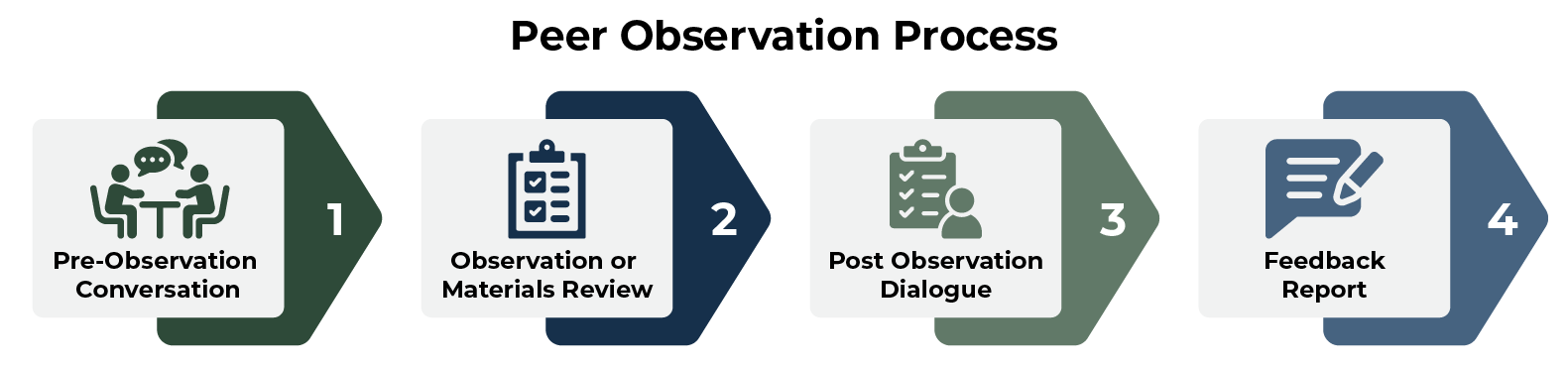
- Identify goals and focus areas such as engagement, course alignment, organization, critical thinking or feedback List of Protocols (Colorado University of Boulder)
- Share course information and syllabus (and other materials, if applicable).
- Discuss course materials and tools relevant to classroom observation.
- Discuss any relevant information about class dynamics.
- Determine the particular concerns of the instructor.
- Review the classroom visit and logistics (where should the observer sit, if/how the observer should be introduced, etc.)
- Schedule time to arrive early and stay until the last student has left.
- Bring a copy of the appropriate peer observation template for reference. (open -ended, checklist, or rubric).
- Take evidence-based notes aligned to the chosen tool.
- Record what the instructor and students do. Include quotes and examples.
- Invite the instructor to begin by sharing their reflections. What sense did they have of the class and what worked and didn’t work? How did class play out in expected and unexpected ways?
- Solicit questions the instructor has about your report or suggestions.
- Elaborate on the strengths and areas of improvement you noted.
- Offer 2–3 recommendations and 1–2 actionable suggestions; link to resources if available.
- Provide a simple feedback report.
Observer should provide a written report that includes both the summary or log of the session and feedback on the class. Effective peer feedback is:
- Descriptive—of the actions rather than personality
- Specific—rather than general
- Directed—toward behavior and action that can be changed
- Timely—offered as close to the teaching event as possible
- Selective—addressing one or two key issues rather than many at once
Providing feedback do’s and don’ts:
- Provide focused, context-specific, and constructive feedback that highlights effective practices and identifies areas for improvement.
- Invite the observed instructor to reflect on the session first to support self-reflection and open discussion.
- Start with a positive observation by identifying a teaching strategy that was implemented effectively.
- Treat feedback as a two-way process; both the observer and observed instructor should engage reflectively.
- Align feedback with the peer observation checklist and any specific focus areas identified during the pre-observation meeting.
- Collaboratively explore alternatives and strategies for improvement where needed.
- Maintain confidentiality of all feedback.
Online Teaching Review Recommendations
Quality Matters (QM) provides nationally recognized standards for the design of high‑quality online and hybrid courses. These standards focus on key elements of effective course design, including learning objectives, assessment, instructional materials, learner engagement, accessibility, and alignment.
The QM One‑Page Rubric offers a simplified overview of the QM Course Design Standards. It is useful as a quick reference when reflecting on course structure and design choices. Faculty often use the one‑page rubric to identify strengths, surface questions, and focus on improvement efforts without engaging in a full course review.
QM also offers online self‑review tools that allow faculty to review their own courses against the full QM standards. These tools support guided, self‑paced reflection and help instructors identify specific areas for course enhancement. Self‑reviews are formative and confidential, making them well suited for individual reflection, course revision, or preparation for peer feedback.
A Peer Review Guide for Online Teaching at Penn State- This peer review guide addresses all four elements of effective teaching:
- Effective Course Design
- Effective Instruction
- Inclusive and Ethical Pedagogy
- Reflective and Evolving Practice
Peer-Review of Online Teaching Guidelines Oregon State University – Provides guidance of a 5-step process and observes Seven Principles of Effective Practices.
Chickering, A. & Gamson, Z. (1987). Seven principles for good practice in undergraduate education. AAHE Bulletin (39)7.
Adaptable Resources
Three download variants to choose what works best for you:
CTLE Support
Our instructional designer is available for an informal Peer Observation. Submit a request here: