
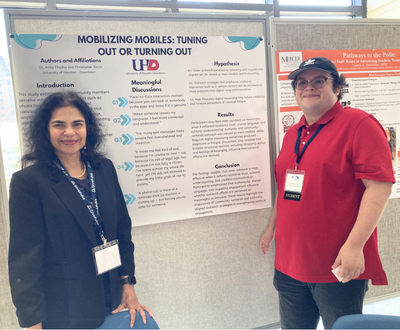
In this article, UHD student Christopher Sierra outlines his research as presented at last spring’s Gulf-South Summit on Service-Learning and Civic Engagement Through Higher Education, which took place at UHD.
In Houston's Heights and Near Northside neighborhoods, we examined how community members perceive and respond to voter outreach strategies like phone banking, text banking, and in-person canvassing. While existing voter mobilization literature often emphasizes measurable outcomes such as voter turnout rates, this project uniquely explores the qualitative aspects of how communities experience these outreach efforts. Our goal was to delve into the community's qualitative experiences with these outreach efforts.
Using data from three community events, we analyzed how participants discussed trust, communication, and their reactions to different outreach types. A significant finding was that the effectiveness of outreach efforts is heavily influenced by the identity of the messenger and the method of delivery. Outreach was perceived as personal and respectful when delivered by individuals who shared the community's language and cultural background, fostering a sense of connection. Shared language and cultural familiarity played a significant role in making people feel comfortable engaging.
Participants also pushed back on some common outreach strategies with textbanking being the biggest one. Participants described this form of outreach as bothersome and repetitive due to the frequency with which they were being sent during an election cycle. They viewed in-person canvassing as more genuine because of the one-on-one human interaction. Some of the participants said that being able to look someone in the eye made the interaction feel more real and trustworthy. One participant shared that although they had lived in the U.S. their entire life, they were not able to participate in an election due to their immigration status.
This project overall shows that voter outreach is not just a technical strategy. It is a social and personal process. Trust, cultural understanding, and authenticity matter just as must as the actual method. Looking at how people interpret outreach helps explain what works and what does not within communities.