
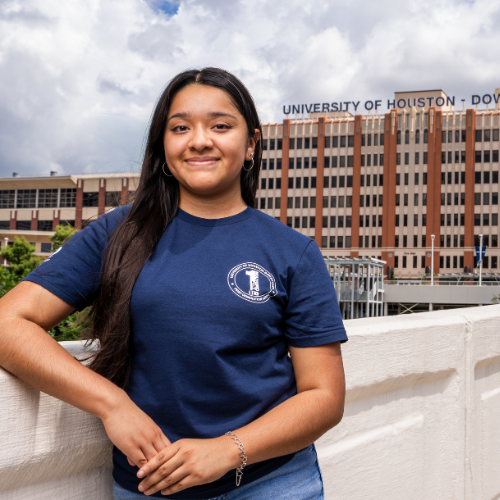
The University of Houston-Downtown (UHD) is expanding its commitment to first-generation students, thanks to a gift of $1.3 million over four years from The Moody Foundation’s M-PACT Fund. At the heart of the UHD’s First-Generation Gator Program (FGGP) is a holistic initiative and approach to student success—one that reflects UHD’s longstanding mission of meeting students where they are and helping them achieve their educational goals.
Take Criminal Justice sophomore Emily Raygoza, for instance. “I started my journey in higher education with UHD because of the support I received when I couldn't find a sense of direction for myself,” Raygoza said. “As an incoming first-generation student, I faced the pressure to transition from high school to college by myself. I had the support of my family, but I felt they could only help me so much.” When Raygoza received an email about UHD's Summer Bridge Program, she enrolled immediately in order to earn college credits at no charge. By the end of the program, she had the confidence to start her fall semester strong.
From that point, the FGGP stepped in as part of a collaboration with the Gator Success Institute, providing Raygoza with a scholarship and other resources such as the Peer Mentoring Program, instrumental in helping first-gen freshmen navigate their first year in college. Raygoza credits the Division of Student Success and Student Life (3SL) for providing her with new opportunities to improve herself while determining her career pathway in law enforcement, which may include pursuing a Master of Science in Criminal Justice or joining UHD’s Law Enforcement Academy after graduation.
“FGGP helped me see what is possible and gave me a clearer direction for my future,” she said. “Having access to these resources helped me better understand my goals and the steps to reach them.”
Stories like Raygoza’s illustrate the impact the university hopes to achieve for first-generation students. Through FGGP, UHD hopes to reach as many students—approximately 70% of whom are first generation—as possible.
“College is for those who want it,” said Dr. Kira Gatewood, Assistant Vice President of Student Life and Dean of Students. “Everyone who wants it should have an opportunity to do it and to do it successfully. And that's our job: We're here to be that champion. Partners like Moody allow us to be able to add to our toolkit to help students be successful.”
That shared commitment recently resulted in a major expansion of UHD’s first-generation initiatives. Following an initial $300,000 award for the 2025-26 academic year and an additional $100,000 to be distributed over subsequent years, UHD recently received another $900,000 of funding from Moody to strengthen and scale resources designed to help first-generation students thrive from enrollment through graduation.
Led through the Gator Resource Center (GRC), the initiative is focused on creating a comprehensive network of support that addresses the academic, professional, financial, and personal needs of first-generation students. The funding allows UHD to coordinate, strengthen, and expand services that already exist across campus, including Career Services and Alumni Relations.
“We’re really looking at building more culture and momentum around supporting first-gen students,” said Dr. Hope Pacheco, Executive Director of the GRC and co-PI with Dr. Gatewood on the M-PACT grant. “We’re able to scale the work that is already happening and amplify the efforts of partners across the university.”
FGGP supports competitive and leadership-based scholarships, peer mentoring, First-Generation Week celebrations, and outreach connecting students with resources. The university also plans to introduce faculty, staff, and alumni mentoring opportunities; programming for graduate students; and Tri-Alpha, the nation’s only honor society dedicated specifically to first-generation college students.
“We’re building on a legacy of support that has existed for years,” Pacheco said. “The funding allows us to refine it and create even more opportunities for our students to succeed.”