
For many people, preparing an income tax return is like learning a foreign language: It can be time-consuming, confusing, and often seems never-ending.
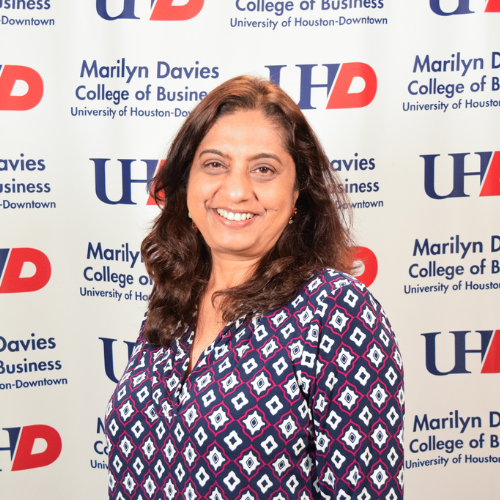
According to Dr. Arpita Shroff, Associate Professor of Accounting and International Business at UHD, the process is even harder for people who file non-resident returns.
“That’s one of the toughest returns we do, because we look at tax treaties between the U.S. and other countries to ensure our non-resident returns are prepared accurately,” Dr. Shroff said. “It’s our specialty. We serve doctors, teachers, and nurses who are non-residents, in addition to students and professors. We also serve people who are residents, of course, and some resident returns are challenging because they include things like tax credits and business-related expenses for small entrepreneurs.”
Dr. Shroff, a Certified Public Accountant who earned a doctorate in Accounting from the University of Houston, spearheads a unique program called the Volunteer Income Tax Assistance Program. This service, which is based in the Shea Street Building on weekdays and One Main Building on weekends at the UHD campus, links volunteer income tax preparers with people who need their services.
This year, more than 50 UHD student and faculty volunteers prepared 806 returns. Of those, more than 85% were accepted by the IRS, for a total amount refunded of $779,000.
The VITA program is provided to clients free of charge. Since 82% of all clients are considered low-income, the program plays a vital role in the community. An average tax return takes between two and three hours to complete—starting with an initial interview and ending when the IRS accepts the return—and students volunteered more than 1,700 hours this year, with faculty adding another 545 volunteer hours.
The process also includes educating people on their rights, Dr. Shroff said.
“I’m a CPA, and I can tell you that most accountants will charge an average of $500 for some of the returns that we prepare for free at VITA,” she said.
The number of returns prepared this year has more than doubled since 2024, when Dr. Schroff took over the program.
“One of the best things about the program—other than the benefit for the community—is that it gives our students real-world experience,” Dr. Shroff said. “Some students have never held a job before, so this gives them an exceptional opportunity to learn how to deal with people and be responsible ... sometimes for the first time.”
Dr. Shroff first came to UHD in 2016 after earning several degrees in her native country of India. She holds a master’s degree in Physics and a master’s of Business Administration degree in Finance, in addition to her accounting degrees.
“I took the first step toward becoming an accountant in this country by enrolling in the master’s program at the University of Houston,” Dr. Shroff said. “I made a “C” in my first class, which is the first and only time I’d ever earned a “C” in my life. So, I decided to teach myself accounting by using a scientific method, which worked.”
Dr. Shroff especially enjoys mentoring students in the VITA program. This year, the program will award a half-dozen scholarships to high-performing student volunteers.
“These thousand-dollar—or more—scholarships can be used for a student’s undergraduate degree or continuing education if they’re enrolled in a master’s program,” Dr. Shroff said.
The IRS recently awarded the VITA program at UHD a $30,000 grant, which was matched by the university. This money helps run the program and fund college scholarships.
The VITA program begins in January each year at UHD when volunteers are trained. Every volunteer is certified by the IRS, and the training includes new topics that come up every year.
“Depending on tax law changes, the training changes,” Dr. Shroff said. “We just had the One Big Beautiful Bill pass, so now the training will include those tax deductions.”
The program will close a few days prior to the April 15th deadline for income tax filing.
“That’s when we close up shop, because we want to encourage people to come to the program early, so we have time to handle any last-minute issues,” Dr. Shroff said. “People are so grateful at the end of the process, it’s really wonderful to see.”