
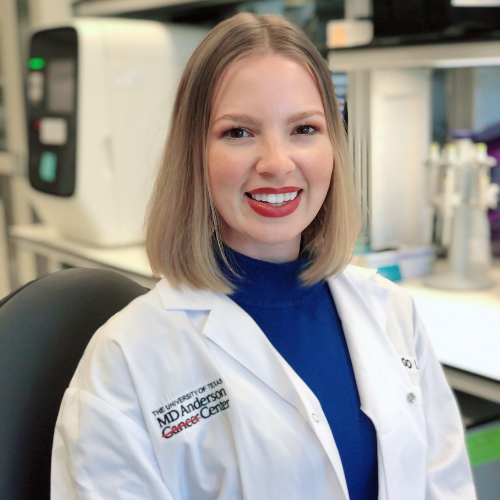
Curiosity has never been a fleeting trait for Dr. Jillian Losh—it has been the driving force behind every major turn in her career. Today, as a respected science administrator and director of one of MD Anderson Cancer Center’s research centers, she has built a professional life rooted in discovery and in the relationships that make discovery possible.
Dr. Losh’s journey began not in a laboratory, but on a stage. Drawn to human connection, she initially majored in theater. After one semester, though, she realized she needed to reassess her direction and took a gap year—a pause that would ultimately reveal her true calling. While working at an equine veterinary office, Dr. Losh assisted with a range of injuries and illnesses, but it was the preliminary screening for infectious diseases that captivated her. “It's been that kind of quest for knowledge and the creative applications aspects of science that has made me so excited and proud to be a scientist,” she reflects.
That spark of interest led her to search for Microbiology programs, eventually discovering the University of Houston-Downtown, located within reasonable distance of her hometown in Oklahoma. Once here, she immersed herself in research, working primarily in the lab of Dr. Lisa Morano, Professor of Microbiology and Biology, as well as with Dr. Poonam Gulati Salhotra, Associate Professor of Microbiology and Biology, and Dr. Akif Uzman, Dean of the College of Sciences and Technology. Faculty encouragement helped her see a PhD as a possibility, but it was conversations with graduate students that made the path feel attainable. This was also when she began cultivating the approach that would define her career: “Networking has been what has gotten me to every position that I’ve had since graduate school.”
During her PhD at MD Anderson Cancer Center UTHealth Graduate School of Biomedical Sciences, Dr. Losh found new clarity about her future. Opportunities to explore science policy and research administration—rare for students at that time—opened her eyes to possibilities beyond the traditional academic track. Her mentor, Dr. Ambro van Hoof, played a pivotal role, offering exposure to this work and instilling a lesson she still carries: “I was not allowed to come into his office with a problem if I had not first brainstormed a potential solution.”
After defending her dissertation, Dr. Losh transitioned into regulatory affairs at Houston Methodist. Her career accelerated quickly from there. She eventually joined the Platform for Innovative Microbiome and Translational Research at MD Anderson, managing a large research portfolio that included numerous collaborations and oversight of fellow laboratory scientists. The work aligned perfectly with her peoplecentered approach. As she explains, “In academia, you can't operate by yourself. That's what has kept me in such a big institution and in the Texas Medical Center. If you want to use some new technology or a technology that you're not familiar with, there's literally going to be someone down the street, somewhere else in the Med Center that has that exact piece of equipment that's probably willing to collaborate.”
Recently, Dr. Losh stepped into an even larger role at MD Anderson as the first director of the new Center for BRCA and Genome Instability. She is currently deep in the work of writing protocols and establishing the center’s physical space—laying the foundation for future scientific impact.
For Dr. Losh, the motivation behind all of her scientific pursuits thus far remains clear. “The diseases that we study affect people all around the world and, although we are here in Texas, we can share our knowledge of different types of treatments, therapies, and prevention techniques to much of the global population. I think that is something that we will always be excited about as scientists.”