
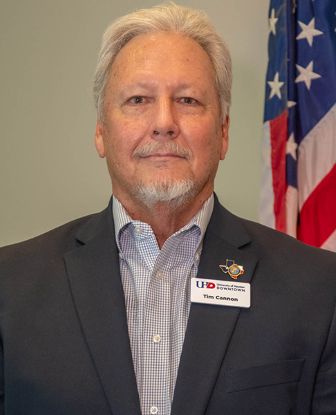
Tim Cannon, Director of UHD’s Law Enforcement Academy, brings more than four decades of experience to his role and, as you might expect, he’s seen virtually every aspect of the field, having worked as a deputy as well as in administration, narcotics, and tactical operations. He went on to later serve as Chief in both the Harris and Montgomery County Sheriff’s Offices. It is surprising, then, that the thing he most wants to provide is something he didn’t see all that much: mentorship.
“In all professional environments we want to learn from those who have already been down the path and not have to recreate the wheel for ourselves,” said Cannon. Early in his career, he realized mentorship was not “intrinsic to the environment,” and that if he wanted guidance, he’d have to seek it out himself. “I was able to do that with one of my instructors, who stayed with me through most of my career.”
And so, one of his goals in the academy (one of the region’s few state-certified peace officer programs) is to proactively provide cadets with guidance. Leaving nothing to chance, the entire program is structured so that cadets receive instruction in the harsh realities of law enforcement, as well as in leadership, decision-making, communication, and how to operate with clarity under pressure.
It’s no accident that Cannon is interested in leaving a legacy for UHD cadets. Service is woven through the branches of his family tree.
His father, a Marine veteran of the Korean War, was severely wounded at the Chosin Reservoir. His uncles were police officers and, as a child, Cannon kept a photograph of one of them on his dresser, the avuncular figure clad in a crisp uniform, seated atop a motorcycle. “It started young,” he said, speaking of his motivation to enter law enforcement. Even his son serves as a crime scene investigator with the Montgomery County Sheriff’s Office.
Having attended UHD in the late 1970s, he now returns to shape cadets in the way that service and mentorship shaped him. How? For one, excellence is non-negotiable. Cadets must score at least 80% on all of their exams, complete the 736 hours of training, perform well in scenario testing, maintain a rigorous physical fitness routine, and grow along leadership and decision-making lines. They cannot miss a day of class.
Cannon guides these men and women as they enter a consuming professional environment filled with procedures, policies, risks, and uncertainties. “We create real world environments and soak them into that,” he said.
In addition to scenario immersion, all cadets are drilled on the core competencies required by the state, resulting in a well-rounded individual, ready for public service. “It's very rewarding to see the process of maturity. They come in here not knowing a whole lot. After six months, you see how they’ve matured.” That maturity is a must, he says, as he routinely tells them they will be tasked with “making big decisions” while on the job.
With more professional years behind him than ahead, Cannon is at UHD for a simple reason: When a cadet graduates, earns a badge, and is faced with difficult decisions, they are prepared to make the right call.