
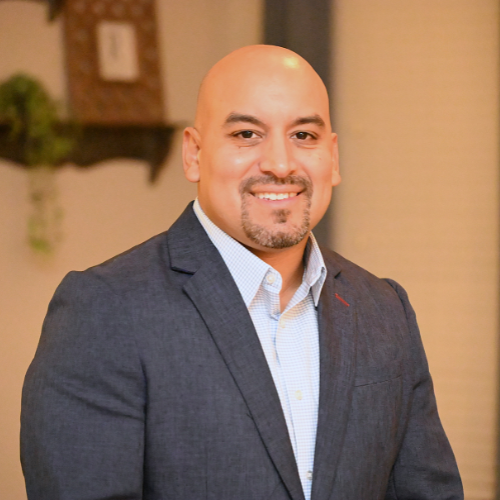
Elias Rivera entered University of Houston-Downtown's Criminal Justice program in 1999 with a clear goal: become a police officer. At the time, he was 18 and already working at the Harris County Sheriff's Office nearby. The work enabled him to balance a full-time job with school, often studying during overnight shifts. "I literally got paid to do my homework," he recalled.
One of the most influential figures during Rivera's undergraduate years was a professor outside his major. Rivera credits his Speech Communications instructor with sharpening skills that would later bolster and guide his professional success. "I think public speaking today is a profound asset to have because it transcends a specific sector," he said, noting its importance across public service, private industry, and everyday life.
In order to make the leap from deputy sheriff to crime scene investigator, Rivera returned to the university in 2011 to earn a Master of Science in Criminal Justice. "You have to know how to write. Critical thinking and writing skills are very important in law enforcement, especially in homicide investigations," Rivera explained.
Looking back at his experience as a student, Rivera noted, "One thing that I loved about my professors, both at the undergraduate and the graduate levels, is the fact that most of them were actual practitioners in the field. All of them were very passionate." This lasting impression later inspired Rivera to pursue a teaching career on top of his new homicide CSI duties.
Almost precisely two decades after starting both his undergraduate degree and his law enforcement career, Rivera found his way back to campus as an adjunct professor. The opportunity arose after he was invited to speak at an alumni event, after which faculty leaders encouraged Rivera to apply for a teaching position. Soon thereafter Rivera began teaching Death Investigations and Criminal Investigations courses, with the aim to "bring that same level of commitment and passion" as his UHD instructors.
In his own classes, Rivera emphasizes the connection between theory and practice. While students respond strongly to personal accounts of homicides he's worked on, Rivera sees them as a way to give students a peek behind the curtain at both the technical and emotional realities of investigative work.
Since starting in 2019, Rivera has become equally motivated by the students themselves: "It's kind of like a concert that when you go see a band live—any band will tell you that they feed off the crowd. If my students are engaged, then I'm more motivated to give them my very best. The students at UHD are hardworking. They're earning their grades. They're working hard. They're tenacious. They're eager to learn. They're hungry."