
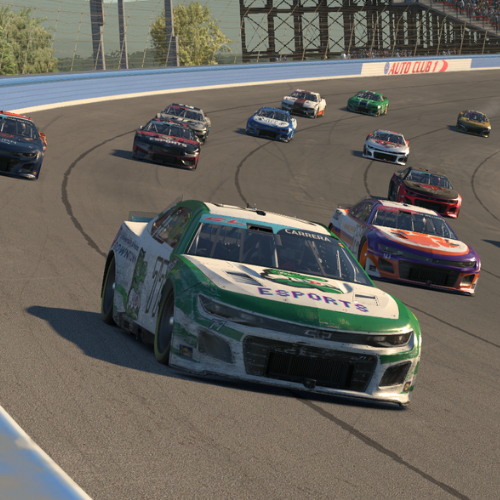
For Miguel Carrera-Castillo, iRacing—an organized, highly technical form of virtual racing—has grown from a pandemic hobby to both a competitive arena and a community-building effort on campus.
“Motorsports is a huge passion of mine. I've always wanted to do some kind of racing, whether virtually or in the real world,” he said. “So when I heard of iRacing early into the pandemic, it was something I wanted to pick up.”
After relying on console games like Forza and the F1 Series, Carrera-Castillo eventually acquired a Moza R5 wheelbase, which was key in becoming a competitive racer. Carrera-Castillo attests that contenders must dedicate themselves to learning how to handle each car they drive. “No car is ever going to behave the exact same way as another one does. If you're driving multiple series, you have to always adapt to multiple cars as well as track.” Building an online community was key in staying motivated and logging in the necessary hours to become comfortable at the wheel.
Competition is intense in the collegiate iRacing landscape. Hundreds of racers compete in each of the two major leagues, the eNASCAR College iRacing Series and the Collegiate iRacing League (CiL). Carrera-Castillo’s consistent weekly practice has paid off, though: Last spring he won one of the eNASCAR College iRacing Series, only his third time racing at an event of that scale. And Carrera-Castillo is now wrapping up a solid performance in the CiL YumTwo College Cup Series. He has one last race in early December this semester, the culmination of approximately four months of weekly races.
But technical skills and competitive leagues only account for part of the experience. Community drives the rest.
UHD’s eSPORTS Center, headed by Coordinator Ricky Rodriguez, provides access to specialized equipment and a variety of teams, including ones dedicated to Super Smash Bros., FIFA, and Fortnite. As a student worker with experience supporting multiple esports teams through the Center, Carrera-Castillo has taken the lead in developing UHD’s iRacing division.
Initially recruiting new members meant quite literally bringing the sport to campus. “I would bring my own equipment from home and bring it on campus and show it off to people telling them, ‘This is what you can be a part of,’” he explained. Carrera-Castillo expects even more accessibility soon, though—the University is actively working on building two racing rigs. Students will be able to start racing on campus by the end of the fall semester.
For those curious about joining iRacing or another eSport, Carrera-Castillo stresses that the doors are open. “Esports is always open to everybody. There's no reason to be intimidated… With iRacing being brand new, it's something I've been heavily wanting to push. I'm hoping that one day we may see the iRacing team and maybe have eSPORTS grow as a whole. So we make it a staple of what the University is all about, community.” Inexperienced players are more than welcome to try out a new game and receive mentorship from other students.
Students can visit the eSPORTS Center any weekday from 12 p.m. to 5 p.m. to check out the space, meet new people, and try their hand at an esport.